As we enter the second half of an already turbulent 2022, we hear over and again that investors are laser-focused on the short-to-midterm view for crude prices. This is particularly interesting since crude prices have current retreated from the $115 level to the high $80’s in the past 3 weeks.
At Warwick, we are always focused on the long-term signal: the nearly ten years of underinvestment in global oil and gas production, the strength of demand for oil products globally versus the noise: the day-to-day price reaction to broader geopolitical and economic headlines.
That said we wanted to write you what we are seeing.
In debating internally whether oil is headed towards $50 or towards $120, we can make very strong arguments in both directions. So we decided that was actually the most important thing for us to tell you.
Symmetric tail risk for oil to both the upside and downside is as robust and potentially volatile as we have seen at any point in our careers with a combined 50 years of trading commodities.
To steal from Charles Dickens, it’s truly “A Tale of two Tails”.
Many global recessionary indicators are flashing yellow, if not outright red.
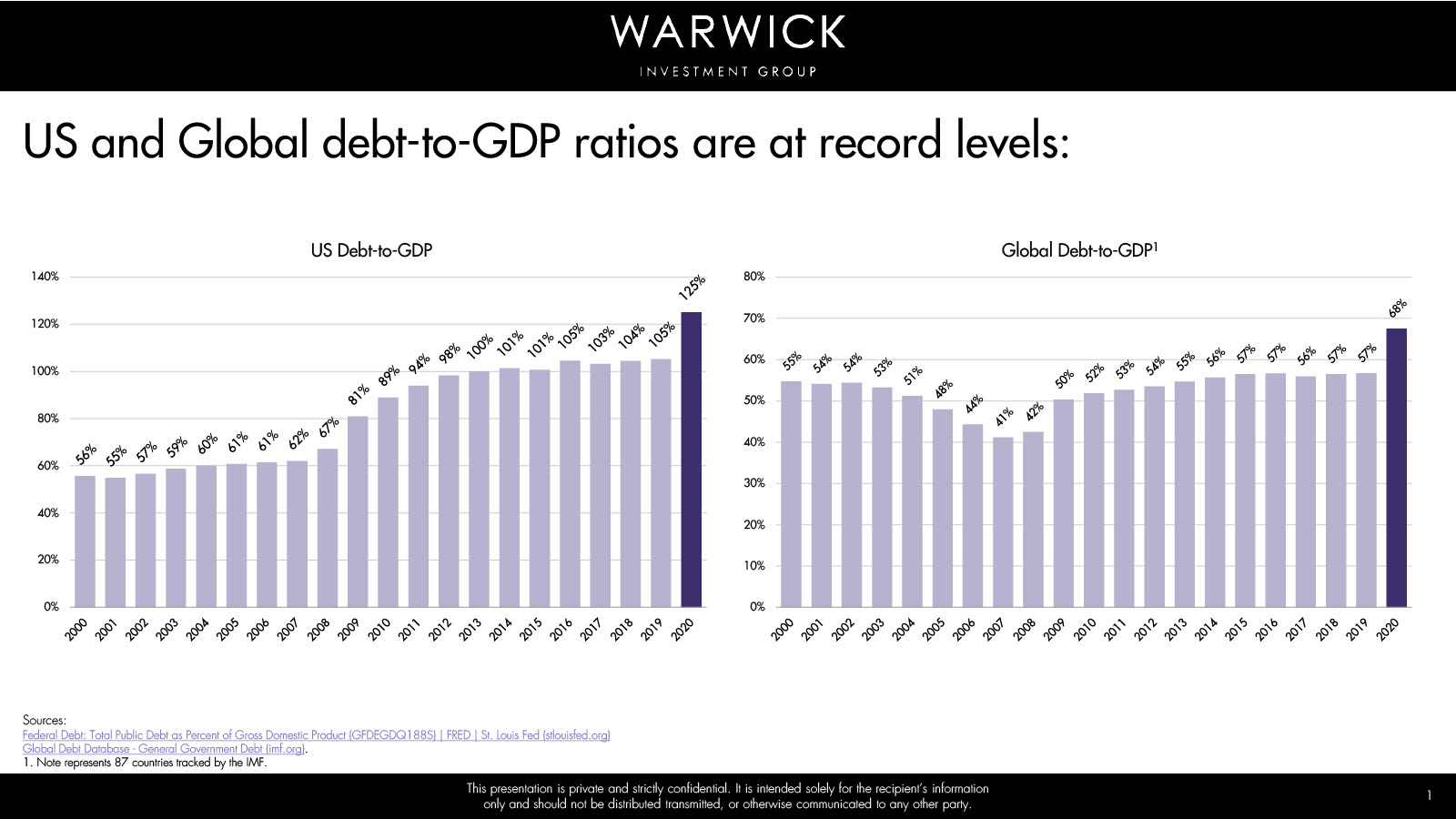
Both US and global debt to GDP ratios are at record levels as we move into in a higher interest rate regime.
At 120% debt to GDP, the US is nearing the 130% Debt to GDP mark that has triggered many defaults over the past 200 years
After nearly 15 years of unrelenting quantitative easing and accommodative monetary policy, central banks appear willing to accept heightened volatility in order to maintain credibility and fight inflation. We see this in the US, EU and UK.
As you probably know, the dollar has rallied aggressively. This is important because usually the dollar and crude prices move inversely, so that when the dollar is down, crude rallies and vice versa. Since March, the US Dollar has rallied while much of the commodity complex has collapsed, notably copper and iron ore are both down 30% since March, and this does not bode well for crude prices. Every time the dollar has risen this rapidly, it has resulted in dampened global demand growth expectations and driven crude prices down.
Over 70% of crude consumption is by people who do not purchase oil with dollars. So a stronger dollar means that crude is even more expensive for those outside the dollar system, which usually weakens oil demand and prices. This is one reason we can make a strong argument for near-term oil price bearishness.

Additionally, the consensus is China’s GDP growth is slowing and is set to underperform the US for the first time in 30 years. This is huge. China has been the main driver of crude demand growth for many years, so this really matters in terms of sentiment around oil prices.
Remember, this is a market that is often not dictated by fundamentals. In 2016, for example, a 2% oversupply in crude markets triggered a 60% price decline. So this commodity can definitely overshoot fundamentals
A stronger dollar, rising interest rates and slowing global economic growth, and you can make a strong argument for a bearish outlook for crude.
While we are deeply concerned about these bearish factors just discussed, the bullish argument is rooted in the structural underinvestment in upstream energy space, against resilience of crude demand growth. Almost irrespective of whether oil prices go towards $40 or $50 a barrel in the near-term, this could be the cycle that defies what traditional macro indicators are telling us.
Global oil and gas CAPEX was at a 15-year low in both 2020 and 2021 and in fact, it has been on the decline since 2014. This underinvestment is now showing up in the supply-demand picture.
Unlike the 1970’s, or 2007-2008, this is not a global oil crisis but a global energy crisis. Look no further than Europe or even Texas facing supply issues in the heat of summer. To bridge the supply-demand gap, there is no quick fix.
Typical sources of spare capacity seem to not exist. Saudi spare capacity or their willingness to grow production in a meaningful way is null. The Strategic Petroleum Reserve is a band-aid which will have to be restocked at some point. Public E&Ps have learned to prosper within their financial means, preferring dividends and share buy-backs over production growth and exploration.
Simply said, historical underinvestment in the oil and gas sector, long-cycle investment cycles, and limited spare capacity amongst supply shortages make for a strong bullish outlook for crude.
The tail risks are as high as we’ve seen in our career, with continuing global uncertainties, but volatile crude prices seem to be the only certainty as we enter the second half of 2022.
At Warwick, we are prudently growing our lowest cost production in this environment, while remaining vigilant as we rationalize and high-grade our portfolio and gear up to invest in the new fund. Most importantly, across our Warwick upstream energy funds, our current production is currently 90% hedged at ~$70/bbl. over the next 12 months and we stay hyper-focused on the long-term signals and on removing tail risk from our portfolios.
To whether the likely volatility, stay hedged, remain in low break-even parts of basins, keep debt low and watch your macro carefully. As we always say, manage to your bear case! The bull case will take care of itself.