
the US E&P Industry
The Dallas Fed released its quarterly Energy Survey which collects responses from 141 energy firms and the report was filled with all-time highs.
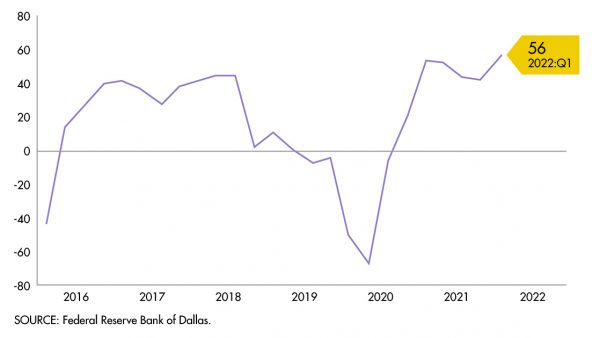
- Oil and gas sector activity index reached an all-time high (56.0)
- Cost index increased for a fifth straight quarter, while finding & development and lease operating expense indexes both reached all-time highs
- The index of prices received for oilfield services reached an all-time high
- All labor market indexes (employment, hours, and wages) reached all-time highs
The six-month outlook for management teams reached an all-time high jumping from 53.2 in the 4th quarter of 2021 to 76.3 in the 1st quarter of 2022
DALLAS FED ENERGY SURVEY BUSINESS ACTIVITY INDEX
E&Ps are clearly looking to add activity in this environment, but supply chain constraints and inflation are the governors of activity.
Warwick’s operating team made bulk purchases in 2021 and is using unique logistical solutions to alleviate inflation and supply chain issues.
the US E&P Industry
The Dallas Fed released its quarterly Energy Survey which collects responses from 141 energy firms and the report was filled with all-time highs.
- Oil and gas sector activity index reached an all-time high (56.0)
- Cost index increased for a fifth straight quarter, while finding & development and lease operating expense indexes both reached all-time highs
- The index of prices received for oilfield services reached an all-time high
- All labor market indexes (employment, hours, and wages) reached all-time highs
The six-month outlook for management teams reached an all-time high jumping from 53.2 in the 4th quarter of 2021 to 76.3 in the 1st quarter of 2022
DALLAS FED ENERGY SURVEY BUSINESS ACTIVITY INDEX
E&Ps are clearly looking to add activity in this environment, but supply chain constraints and inflation are the governors of activity.
Warwick’s operating team made bulk purchases in 2021 and is using unique logistical solutions to alleviate inflation and supply chain issues.
Noise in the Oil Markets
It pays to pay attention to the true signals in times of uncertainty. Recent conflict-induced volatility is the noise. We prefer to listen to the signals: the structural drivers of the supply deficit.
The Russia Ukraine situation is certainly a tragic headline catalyst impacting recent oil volatility. Yet prices remain less than 7% than pre-invasion. More importantly the oil market is continuing a strong upward price trend that began once the prospects for a global recovery from COVID brightened in Q4 2020.
Years of underinvestment and a newfound financial discipline by US shale coupled with a greater call on OPEC crude (and OPEC discipline) not to mention persistently loose monetary conditions are the true drivers of the tightest supply and demand imbalance we have seen in 15 years.
As institutional capital preferences continue to favor long term bets to fund the energy transition, we do not see a supply demand rebalancing on the near horizon. Amidst this backdrop, Warwick is uniquely positioned to prudently, and economically grow production into a period of increasing demand.
Additional shorter term macro factors driving oil prices include:
- Sanctions on Russia
- China’s lockdown responses to new COVID cases
- Strategic Petroleum Reserve releases
- US politicians calling for additional E&P spending while talking about reducing longstanding tax incentives
- OPEC short term policy decisions given all the above and their desire to stabilize the market
We believe physical markets are tighter than the futures market is implying. We see risk skewed to the upside in both oil and gas markets. As planned, we are taking advantage of higher prices with WP3 operated development and accelerating operated development in WPIV. We are bringing on many of our unhedged upside locations over the next six months and will hedge production well above our original underwriting models.
It pays to pay attention to the true signals in times of uncertainty. Recent conflict-induced volatility is the noise. We prefer to listen to the signals: the structural drivers of the supply deficit.
The Russia Ukraine situation is certainly a tragic headline catalyst impacting recent oil volatility. Yet prices remain less than 7% than pre-invasion. More importantly the oil market is continuing a strong upward price trend that began once the prospects for a global recovery from COVID brightened in Q4 2020.
Years of underinvestment and a newfound financial discipline by US shale coupled with a greater call on OPEC crude (and OPEC discipline) not to mention persistently loose monetary conditions are the true drivers of the tightest supply and demand imbalance we have seen in 15 years.
As institutional capital preferences continue to favor long term bets to fund the energy transition, we do not see a supply demand rebalancing on the near horizon. Amidst this backdrop, Warwick is uniquely positioned to prudently, and economically grow production into a period of increasing demand.
Additional shorter term macro factors driving oil prices include:
- Sanctions on Russia
- China’s lockdown responses to new COVID cases
- Strategic Petroleum Reserve releases
- US politicians calling for additional E&P spending while talking about reducing longstanding tax incentives
- OPEC short term policy decisions given all the above and their desire to stabilize the market
We believe physical markets are tighter than the futures market is implying. We see risk skewed to the upside in both oil and gas markets. As planned, we are taking advantage of higher prices with WP3 operated development and accelerating operated development in WPIV. We are bringing on many of our unhedged upside locations over the next six months and will hedge production well above our original underwriting models.